
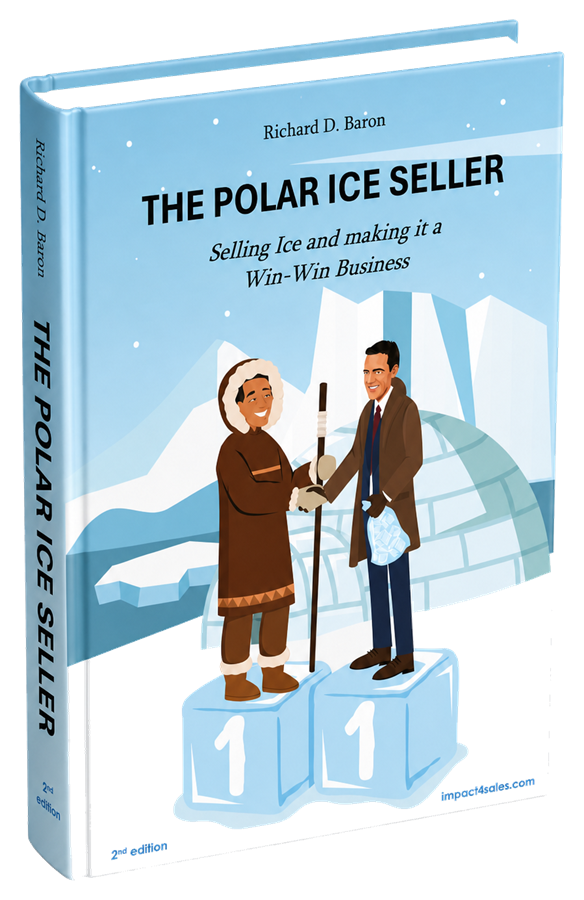
The Polar Ice Seller is the practical entry point into the Impact4Sales method. It turns sales training into a story that is easy to remember and useful in real conversations. Through buyer scenes, practice snippets, reader reflections, and the 7-step sales process, the sales skills eBook helps sales professionals prepare more clearly, ask better questions, and guide buyer decisions with respect, structure, and confidence.
The central case is deliberately simple: a seller wants to sell ice in a polar region. At first sight, that sounds absurd. That is exactly why the example works. If the seller only talks about the product, the sale dies immediately. If the seller understands the buyer, the context, the use case, the timing, the risk, the convenience, and the measurable value, the conversation changes.
The eBook can be read as a stand-alone guide or used together with the Impact4Sales online sales training courses. The book gives the method a memorable narrative frame, while the courses turn the same ideas into structured lessons, worksheets, and practical application.
The reader learns how to look at a sales conversation before rushing into product arguments. The sales skills eBook shows how to slow down, understand the buyer’s situation, and recognize what has to be clarified before a useful offer can be made.
The story format makes the method easy to remember. The Polar Ice Seller becomes a recurring thinking model for preparation, buyer dialogue, requirements, positioning, objections, agreement, and closing.
How the analogy works
The ice buyer in the story is treated as a serious customer, not as a cartoon figure.
The buyer does not buy because the seller is clever.
The buyer buys only if the seller discovers a real motive and makes the value clear.
That is the discipline of professional selling: understand first, structure second, present third.
Language note: Eskimo, Inuit and regional usage
The historic phrase “Selling Ice to Eskimos” is well known in sales language, but it is not the wording we should build the book around. The terms are regional and culturally sensitive. In Canada and Greenland, “Eskimo” is widely treated as outdated or offensive and should be avoided. “Inuit” is preferred when referring to Inuit in Canada and Greenland, while Alaska includes different peoples and language groups such as Inupiaq, Yupik, Sugpiaq/Alutiiq and others. The cleanest editorial decision is therefore to use “polar-region ice buyer” or simply “the ice buyer” in the story, and mention the historic phrase only in a short language note.
The sales skills eBook works as a practical companion to the Impact4Sales online sales training courses. It gives the method a memorable story, while the courses turn the same thinking into structured lessons, examples, worksheets, and practical exercises.
Readers can use the book before starting the courses to understand the overall logic, during the lessons to connect concepts with buyer situations, or afterwards as a compact reminder for real sales conversations.
Our definition of selling:
Selling is to discover the general and personal motivations of your partner and satisfy these to mutual benefit

Our goal of selling:
A WIN-WIN SITUATION IS CREATED
The Polar Ice Seller is the written companion to the Impact4Sales training method. It takes the well-known sales expression of “Selling ice to Eskimos” and turns it into a practical, respectful, and memorable learning story. The focus is not on pushing, persuading, or trying to talk somebody into something they do not need. The focus is on understanding the buyer’s world so clearly that the seller can create relevance, reduce uncertainty, and help the buyer move toward a decision with confidence.
At the center of the book is the Polar Ice Seller, a sales character who faces one of the hardest commercial challenges imaginable: selling something that, at first glance, appears unnecessary. This makes the story useful, because many real sales situations feel exactly like that. A buyer may already have a supplier, may not see the urgency, may not understand the value, may fear risk, or may simply believe that the current situation is good enough. The seller’s task is therefore not to “convince” the buyer, but to discover what truly matters, identify where value can be created, and build a conversation that helps the buyer recognize a better path.
The book follows the same logic as the online modules. It explains selling as a structured human process built on contact, atmosphere, requirements, positioning, objections, agreement, closing, and future business. Each step is connected to the next. The reader sees how a sales conversation develops from first attention into trust, from trust into understanding, from understanding into relevance, and from relevance into a decision. This makes the sales cycle easier to remember and easier to apply in real customer conversations.
A major strength of the book is its practical storytelling. The Polar Ice Seller meets different buyers in demanding environments. Some buyers are cautious. Some are under pressure. Some have been disappointed before. Some are interested but not yet ready to act. Through these situations, the reader can observe how the seller listens, asks better questions, changes perspective, handles resistance, and keeps the conversation on a professional level. The story gives the method more life, because it shows not only what to do, but also why the behavior matters.
The book also contains many practice snippets. These short sections translate the story into everyday sales work. They help the reader recognize familiar moments: a buyer who says “send me information,” a meeting that loses direction, a discount request at the last second, a weak opening question, or a product presentation that starts too early. These snippets are useful because they make the reader pause and think: “Where does this happen in my own sales conversations?” That reflection is often where real improvement begins.
For learners using the online modules, the eBook works as reinforcement and preparation. Before watching a lesson, the reader can use the related chapter to understand the mindset behind the topic. After watching the lesson, the book can be used to repeat the key ideas in a different format. Before a customer meeting, selected snippets can support preparation: What is my objective? What do I need to understand? Which questions will open the conversation? Where could the buyer hesitate? What would a good next step look like?
The book is especially helpful for building a more disciplined sales mindset. It reminds the reader that professional selling is not a collection of tricks. It is a behavior pattern. The buyer must feel understood, respected, and guided. The seller must stay clear, observant, and purposeful. The best sales conversations are not won by pressure. They develop because the buyer begins to see a relevant benefit, lower risk, and a credible reason to move forward.
Used together with the modules, The Polar Ice Seller becomes a practical guidebook. The modules teach the structure. The book deepens the thinking. The snippets train recognition. The reflection questions support personal transfer. This combination helps the learner move from knowing the method to using it with more confidence, more precision, and more consistency in real conversations.
This eBook is included for free in any of the purchased modules
Foreword – A familiar expression, rebuilt with respect
5
Recommendation – How to use this book
7
Core Chapter – What selling means in Impact4Sales
8
Chapter 1 – The market where nobody asked for ice
11
Chapter 2 – Different buyers, different cold
14
Chapter 3 – The person behind the buyer
16
Chapter 4 – Motivation, not manipulation
18
Chapter 5 – Who flipped the switch?
20
Chapter 6 – The human pattern in B2B and B2C
23
Chapter 7 – Problem-oriented or solution-oriented?
25
Chapter 8 – Looking through the buyer’s eyes
28
Chapter 9 – The Sales Cycle as a map, not a cage
32
Chapter 10 – The seven steps of the Sales Cycle
35
Chapter 11 – After closure: reputation and future business
51
Chapter 12 – Preparation before the next conversation
53
Closing Note – The seller who became useful
56
Connection to online modules and corporate training
58
Prefer the full learning path? Explore the Complete Program with all three modules, practical worksheets, and the eBook included.
About the Autor
Richard D. Baron is the founder of Impact4Sales and the author of THE POLAR ICE SELLER. Born and raised in Switzerland, he studied chemistry in Switzerland and later earned an MBA in the United States. His professional path combines Swiss precision with international business experience from corporate and entrepreneurial environments in Europe and the USA.
This background shaped the Impact4Sales method: analytical enough to bring structure into complex sales situations, practical enough to be used immediately in real conversations, and human enough to respect the buyer as an active decision-maker. Richard has worked with salespeople, managers, entrepreneurs, and corporate teams across industries and cultures, always with the same core question: what must happen in the buyer’s mind before a decision can move forward with confidence?
THE POLAR ICE SELLER translates this approach into a story-based guide. The book connects directly with the Impact4Sales online modules, practical worksheets and PDF tools, classroom training, pitch coaching, and corporate sales development programs. Its central message reflects Richard’s work as a trainer and coach: strong sellers do not push harder. They understand better, structure clearer, listen deeper, and motivate the buyer toward a result that both sides can defend, repeat and recommend.

We use essential cookies to operate the website and optional cookies to understand site performance. Choose whether to allow statistics and marketing cookies. You can change your choices at any time.