When B2B solutions appear similar, the sales professional becomes the differentiator. Empathy, judgement and trust give buyers the confidence to choose—and defend—their decision internally. Impact4Sales develops these decisive personal sales behaviours.
Better sales begins with how the buyer experiences the conversation
B2B buyers rarely evaluate technical capability in isolation. They also consider how it feels to work with the people behind that capability.
Do the professionals listen? Do they understand the situation before recommending an answer? Can they work together when priorities change or pressure increases? Does the conversation create clarity and confidence?
That experience matters especially when several qualified suppliers appear capable of delivering the technical result. The difference may then come from observable human behaviour: empathy, professional curiosity, active listening, relevant follow-up questions and answers grounded in what the buyer has actually said.
The Impact4Sales method develops this behaviour without turning the conversation into a script. It helps professionals use their existing expertise in a way that feels relevant, credible and constructive to the buyer.
Four principles guide the method
Principle 1
Understand before presenting
The conversation should begin with the buyer’s situation, not with a prepared solution. Active listening gives the professional the context needed to decide which questions, examples and capabilities are genuinely relevant.
Principle 2
Create relevance together
Value is not a list of product features or company credentials. It becomes meaningful when expertise is connected with the buyer’s priorities, risks, desired outcomes and decision criteria.
Principle 3
Motivate rather than manipulate
The purpose is not to pressure or convince a buyer. It is to create sufficient relevance, clarity and confidence for the buyer to recognise a worthwhile next step and choose it voluntarily.
Principle 4
Create a genuine win-win outcome
A sustainable sale should produce meaningful value for both buyer and seller. The buyer gains a credible path toward the required result. The seller gains business that can be delivered responsibly and developed into a constructive working relationship.
A structured orientation system, not a memorised script
Every buyer conversation is different. Stakeholders, priorities, risks and decision processes change. A rigid script can therefore make a professional less attentive to what is actually happening.
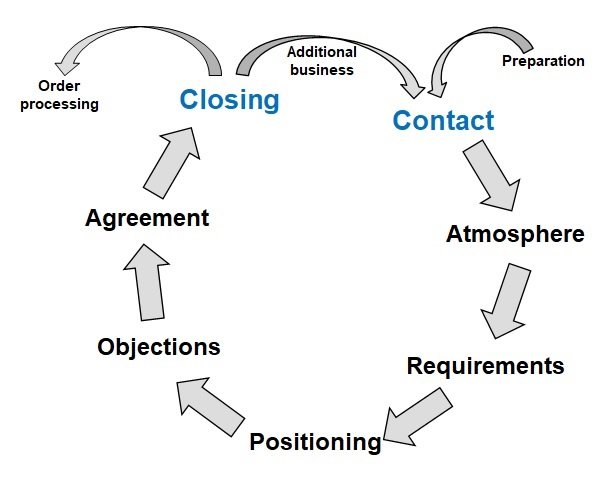
The Impact4Sales seven-step process helps professionals understand where they are in the conversation, what still needs to be learned and which behaviour can help the buyer move forward.
The Impact4Sales seven-step sales cycle provides orientation throughout the buyer conversation.
The sequence creates discipline, but it does not replace judgement. Professionals still need to listen, adapt and respond naturally.
From knowledge to observable behaviour
Knowing a sales concept is not the same as using it effectively while a buyer is speaking, hesitating or challenging an assumption. Practical development therefore needs more than information.
Understand the concept→Practise the behaviour→Apply it in a real buyer situation→Receive feedback→Refine the next conversation
This cycle makes learning visible. A leader or participant can observe whether the professional creates enough space for the buyer, follows up on what was heard, positions only relevant value and ends the conversation with shared clarity about the next step.
One method, three ways to apply it
Independent online learning
Professionals can build the foundation independently, online and at their own pace. The learning path combines communication awareness, practical tools and the structured sales process so that ideas can be applied directly in real buyer conversations.
Organisations can establish a shared baseline and then add facilitated practice, feedback and real company situations. This helps teams translate common language into behaviour that can be observed and strengthened over time.
Teams preparing an important pitch can apply the same principles to one specific buyer decision. The work focuses on buyer relevance, coordinated team behaviour, purposeful rehearsal and the confidence the client should experience.
Developed through real B2B sales and learning environments
Experience behind the method
Richard D. developed the Impact4Sales approach through practical sales work, training and coaching across professional services, technology, logistics and medical technology. His experience spans Europe and the United States and combines behavioural awareness, practical communication tools and a structured B2B sales process.
The method has evolved through repeated application: observing what helps buyers open up, what causes professionals to present too early, how teams behave under pressure and how practice with immediate feedback can improve an important client conversation.
Credibility should come from specific, supportable information rather than inflated promises. Evidence on Impact4Sales is therefore organised around four questions:
ContextWhat commercial situation or learning need existed?
ObjectiveWhat needed to improve or become possible?
ApplicationHow was the method used?
ResultWhat can be stated and supported responsibly?
Selected examples and case studies will be added only when their wording, attribution and evidence have been verified. Where Impact4Sales was not the contracting provider, the role and historical context must be stated clearly. Where a result cannot be substantiated, it should not be presented as proof.
Frequently asked questions
Is the Impact4Sales method a script?
No. The seven-step process provides orientation, but it does not prescribe identical wording. The professional must continue to listen, interpret the situation and respond naturally.
How is it different from product or presentation training?
Product and presentation knowledge remain useful. The Impact4Sales method adds the human behaviour and conversation structure needed to understand the buyer before selecting what to present. It connects technical capability with the buyer’s real decision.
Can it be applied in professional services and technical sales?
Yes. The underlying principles are relevant wherever expertise must be translated into a confident B2B decision. The emphasis and examples can be adapted for professional services, IT and SaaS, technology, MedTech, corporate learning and complex pitches.
How does online learning connect with corporate practice?
Online learning can establish a flexible shared baseline. Corporate practice then adds company situations, team rehearsal, feedback and management reinforcement. The two formats can be used separately or combined.
Does the method focus on persuasion?
It focuses on relevance, understanding and buyer motivation—not pressure or manipulation. The professional creates the conditions in which the buyer can recognise a credible win-win outcome and make a confident decision.
Does the method guarantee a sale?
No ethical sales method can guarantee a buyer’s decision. It can improve preparation, listening, relevance, team alignment and clarity while leaving the final decision with the buyer.
A practical next step before choosing a programme
Get the Free 24-Questions Sales Diagnostic
Prepare your next B2B buyer conversation before you pitch. Enter your name and email address and we will send you the practical 24-question diagnostic as a secure PDF download.
Your privacy choices
We use essential cookies to operate the website and optional cookies to understand site performance. Choose whether to allow statistics and marketing cookies. You can change your choices at any time.
Functional
Always active
The technical storage or access is strictly necessary for the legitimate purpose of enabling the use of a specific service explicitly requested by the subscriber or user, or for the sole purpose of carrying out the transmission of a communication over an electronic communications network.
Preferences
The technical storage or access is necessary for the legitimate purpose of storing preferences that are not requested by the subscriber or user.
Statistics
The technical storage or access that is used exclusively for statistical purposes.The technical storage or access that is used exclusively for anonymous statistical purposes. Without a subpoena, voluntary compliance on the part of your Internet Service Provider, or additional records from a third party, information stored or retrieved for this purpose alone cannot usually be used to identify you.
Marketing
The technical storage or access is required to create user profiles to send advertising, or to track the user on a website or across several websites for similar marketing purposes.