Buyer Perspective
Questions, listening and positioning help the seller understand the buyer’s distinct requirements before offering a solution.

Build a shared online foundation, then turn it into visible behaviour
through live practice and real client application.

ONLINE LEARNING WITH DIRECT APPLICATION
Impact4Sales gives participants the concepts and language before the workshop. Live sessions can then focus on their buyer situations, difficult conversations and upcoming pitches.
The result is an adaptable learning path that connects individual preparation with team practice. Participants return to the online modules when a real customer meeting makes a particular skill relevant again.
SALES TRAINING AND COACHING EXPERIENCE
Richard D. Baron has successfully delivered sales training and coaching for teams within these organisations.








The logos identify organisations in which training or coaching was delivered. They do not imply a current partnership or endorsement.
THE TRANSFER PROBLEM
Online content can explain a method efficiently. A workshop can create energy and insight. Neither format automatically changes what a salesperson says when a buyer hesitates, challenges the value or brings another stakeholder into the decision.
Impact4Sales connects the formats deliberately. The online program establishes a shared baseline. Facilitated practice makes behaviour visible. Real customer situations provide the context. Feedback and repetition help the learner adjust.

THE IMPACT4SALES DESIGN CHOICE
The program centres on buyer clarity and observable sales behaviour. Technology supports the process without becoming the purpose of the training.
Questions, listening and positioning help the seller understand the buyer’s distinct requirements before offering a solution.
Online lessons establish the shared foundation before valuable live time begins.
Role plays and simulations reveal the language, timing and behaviour that need adjustment.
Learners revisit relevant modules when they prepare an actual meeting, objection or pitch.
THE IMPACT4SALES LEARNING ARCHITECTURE
The capability pyramid shows how one shared foundation can support different depths of live application. It is a design guideline, not a rigid package.
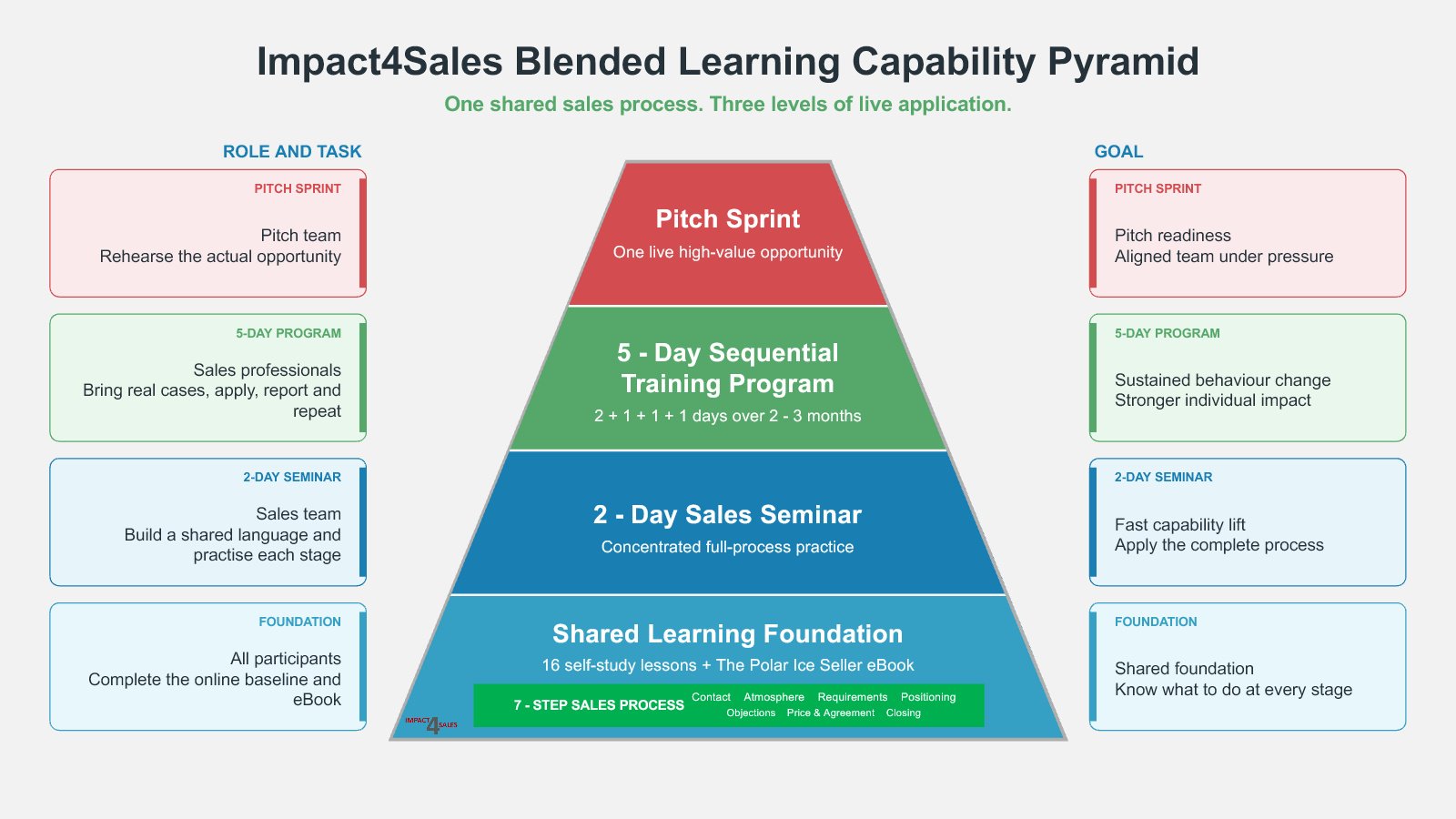
A concentrated route for teams that need a shared seven-step process and practical language quickly. Both days cover the complete sales conversation, with focused exercises and limited depth for company-specific role plays.
Five days delivered as 2 + 1 + 1 + 1 across two to three months. Participants apply selected behaviours between sessions and bring current customer situations back for facilitated role plays, direct feedback and immediate rework.
The later sequences deepen positioning, objections, price and agreement before the final integration day.
Focused preparation for one important live opportunity. The team works on buyer context, storyline, roles, handovers, difficult questions and decisive pitch segments through realistic simulation.
Impact4Sales starts with the desired business situation and the behaviour participants need to demonstrate. Sponsor and participant input identifies recurring customer issues and useful practice cases. Together, we select the appropriate pyramid levels, define confidentiality and feedback principles, and agree how application will be reviewed.
Completion data can support the review, but observable behaviour, manager check-ins and agreed business indicators provide the more useful evidence of transfer.
Download the concise corporate overview, the detailed two-day and five-day program guide, or the focused Pitch Sprint brief.
COMPARING LEARNING MODELS
Each model can be useful. The practical difference lies in how knowledge, practice and real customer work connect.
| Criterion | Traditional training academy | AI-only practice platform | Impact4Sales blended learning |
|---|---|---|---|
| Primary emphasis | Structured content and scheduled teaching | Scalable individual simulations | Buyer clarity and observable behaviour in real conversations |
| Foundation | Often built during instructor-led sessions | Introduced inside the software experience | Compact online baseline completed before live practice |
| Practice | Exercises within the training event | Screen-based interaction and automated feedback | Facilitated role plays using the team’s client situations |
| Feedback | Trainer feedback during scheduled sessions | Automated analysis based on the platform | Immediate human feedback followed by repeated practice |
| Use after training | Depends on the provider’s follow-up model | Continued simulation inside the platform | Return to specific lessons before meetings, objections or pitches |
| Adaptation | Ranges from standard curricula to custom programs | Depends on software configuration and content scope | Program levels, roles and practice cases co-designed around the client’s requirements |
This table compares common design emphases rather than every provider. Individual programs and platforms vary.

LEARNING IN THE FLOW OF WORK
A completed course does not need to disappear into an archive. The online modules remain a practical reference. A learner can revisit questioning before a discovery meeting, objections before a negotiation or the full process before an important pitch.
This repeated use gives the online component a role beyond course completion. It supports preparation when the skill becomes immediately relevant.
FLEXIBLE LIVE APPLICATION
The live component can change without losing the shared online foundation.
Use onsite or virtual sessions to practise complete sales conversations and compare approaches across the team.
Work on one issue such as discovery questions, buyer communication, objections or follow-up.
Prepare a specific client presentation through short simulations, team transitions and direct feedback.
PARTICIPANT PERSPECTIVES
The training helped me build stronger arguments, communicate value beyond price and develop personally.
The training gave me a practical toolbox, a clear structure and greater stability.
The tailor-made in-house seminars were relevant, informative and practical.

ABOUT THE INSTRUCTOR
Richard D. Baron developed the Impact4Sales methodology through practical sales work and classroom training across consulting, tax advisory, insurance, financial services, software, air cargo and medical technology. His approach combines behavioural awareness, practical communication tools and a structured seven-step sales process.
He is also the author of The Polar Ice Seller, an eBook that uses a business story to explore buyer awareness and value-focused communication.
PRACTICAL QUESTIONS
Participants establish a shared foundation through selected online lessons. Live sessions then focus on practice, feedback and real sales situations. Learners return to relevant content when they need it again.
Yes. The live component can use current meetings, account challenges, objections or pitch segments, subject to appropriate confidentiality arrangements.
Yes. Online modules can be combined with virtual workshops, webinars and coaching. Onsite sessions can also be included where they add value.
A concentrated seminar takes two consecutive days. The deeper five-day route normally follows a 2 + 1 + 1 + 1 sequence over two to three months. The final duration and cadence are agreed with the client.
Yes. Managers can support application through check-ins, observation and debriefs. Their role should be agreed during the alignment phase.
Yes. The blend can focus on complex buyer conversations, value positioning, account development or preparation for a specific high-value pitch.
Tell us about the sales environment, target group and business situation. We will use the capability pyramid as a practical guideline to shape a program around your priorities, participant needs and current customer challenges.