
Features vs benefits in sales are often discussed as a wording exercise. In practice, the more important challenge is selection. A familiar pattern occurs in many sales conversations: the seller knows the offer well and wants to demonstrate its full value. One feature follows another, each supported by an explanation, an advantage or a performance claim. The information may be accurate, but the buyer is left to decide which point matters and why.
We call this a feature avalanche: an often-observed sales behaviour in which the volume of product or service information overwhelms the selection of buyer-relevant value. It can occur in an audit or advisory proposal, a financial service discussion, a medical-technology presentation, the sale of another complex product, or a consumer purchase.
The concept is therefore not limited to one market. It applies to B2B service sales and B2B technical sales, and it is equally recognisable in B2C. The car example later in this article is used because it makes the change of perspective easy to see; the underlying principle remains the same across sectors.
A feature avalanche usually begins with good intentions. The seller wants to be thorough, avoid missing an important point and demonstrate expertise. In complex sales, that expertise is necessary: buyers expect accuracy when an offer is technical, regulated, financial or operationally important.
Product knowledge and positioning are nevertheless different skills. Product knowledge answers, “What does our offer contain and what can it do?” Positioning answers, “Which part of our offer matters to this buyer in this situation?”
When every feature and advantage receives equal airtime, the buyer has to perform the seller’s most important task: translate the offer into a reason to care. More information can then reduce clarity. The buyer may understand every sentence and still be unable to explain why the offer deserves a next step.
Sales discussions often treat features, advantages and benefits as separate layers that can simply be added to a pitch. The more important distinction is perspective.
What is the difference between an advantage and a benefit? In substance, they can be the same. What changes is the perspective. A seller talks about a service or product advantage. A benefit is that advantage viewed from the buyer’s side.
The seller’s task is not to rename every advantage as a benefit. It is to use the needs analysis to recognise what this buyer experiences as valuable. The relevant advantage can then be expressed in the buyer’s language and connected to a concrete task, cost, risk, ambition or desired outcome.
This is why a benefit cannot be stored permanently in a product brochure. A brochure can describe potential advantages. The buyer’s situation determines which of them becomes a benefit.
Imagine selling the same compact city car to two buyers.
Buyer 1 is an urban bank adviser. He has few external meetings, public transport is unreliable and his current private vehicle is a large SUV. Buyer 2 works for an advertising agency, does not own a car, is environmentally concerned and is involved with the company’s employee vehicle fleet.
The car does not change between those conversations. Its dimensions, consumption, purchase price, colour options, design and available fully electric model remain the same. Their meaning changes because Buyer 1 and Buyer 2 have different situations and priorities.
For Buyer 1, a compact and reasonably priced car may be a practical second vehicle for occasional city appointments. Low fuel consumption may be true, but limited annual mileage could make it unimportant. For Buyer 2, purchase and running costs can become significant across a fleet. Colour and recognisable design may support an agency image, while a fully electric model may connect directly with environmental and fleet priorities.
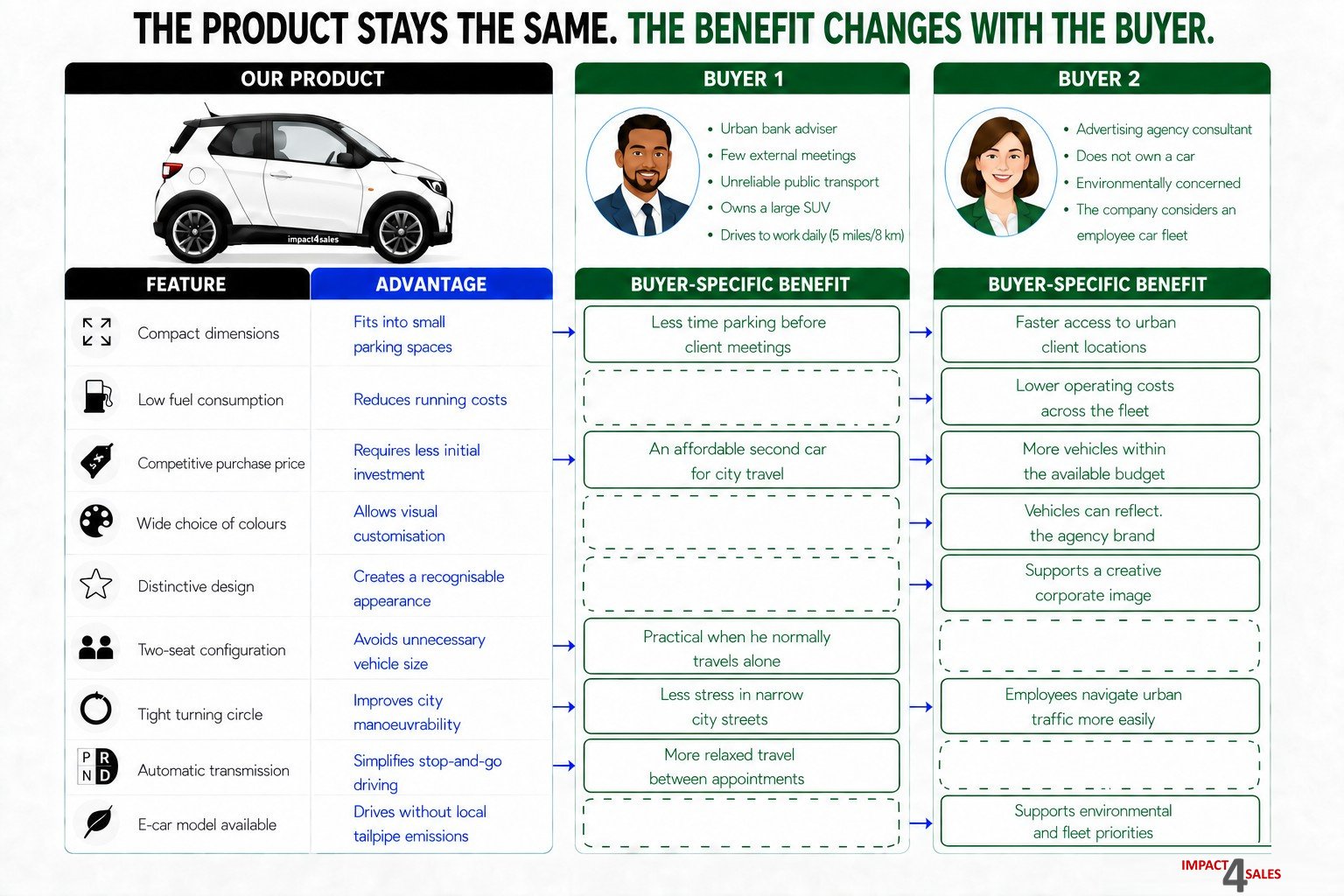
The blank boxes in the matrix are as important as the filled ones. They show restraint. A blank does not mean the feature is defective. It means the seller has no confirmed reason to position that advantage for this buyer.
A seller cannot select the right advantage by guessing what a buyer ought to value. The connection has to come from discovery: the buyer’s current situation, desired result, constraints, priorities and language. Strong discovery begins with relevant open and closed questions in sales and enough room for the buyer to explain the context. The buyer-seller talk ratio therefore matters before positioning begins.
If Buyer 2 says that employees lose time finding parking near city clients, compact dimensions now have a clear role. The seller can connect the feature to easier access and more productive appointments. If the buyer instead says that fleet expenditure is under pressure, purchase price and operating cost move to the foreground.
The wording should remain close to the buyer’s own description. Replacing “our people waste time looking for parking” with “superior urban mobility architecture” makes the positioning sound more sophisticated but less relevant.
The pause matters. Sellers often weaken a strong point by adding three weaker ones before the buyer has time to process the first.
The Polar Ice Seller illustrates the same discipline with an intentionally unusual product. Ice remains ice, but its relevance changes with the buyer. For a harbour master, the meaningful issue may be a reliable transfer during an operational handover. For a hotel owner, it may be the guest’s experience. For an expedition guide, it may be safety and control in difficult conditions.
A catalogue of every possible advantage would be factually impressive and commercially weak. One precisely positioned reason can be stronger because it fits the buyer’s real risk, ambition or task.
Good positioning makes the buyer feel understood. Poor positioning makes the buyer feel that the seller is reciting a brochure. The difference is not clever wording alone. It is the discipline to leave valid but irrelevant information unused.
A useful test is simple: if the same positioning sentence could be delivered unchanged to three very different buyers, it is probably still too generic.
Presenting before understanding. The seller moves into the offer while important parts of the requirement are still assumptions. Potential advantages are then presented as though their relevance had already been confirmed.
Giving every feature equal weight. The buyer cannot distinguish essential capabilities from optional extras because the seller’s tone, slide design and explanation treat them all as equally important.
Using generic benefit language. Phrases such as “saves time”, “improves efficiency” or “increases flexibility” sound positive but remain abstract until they are connected to a specific activity, cost, risk or outcome.
Continuing after the relevant point has landed. The buyer recognises the value, but the seller does not respond to that recognition. Instead, the seller introduces the next feature and thereby dilutes the buyer’s emerging decision.
The answer is not to know less about the product. Sellers should prepare broadly. They need to understand the offer’s features, operational consequences, limitations, proof points and possible value across different buyer profiles.
During the conversation, however, they should present narrowly. Preparation creates options; discovery determines selection. The seller’s expertise becomes visible not through the volume of information delivered, but through the precision of what is chosen.
Before the next positioning conversation, create two columns for the offer: feature and advantage. Then add buyer-specific columns. Leave cells blank whenever no confirmed relevance exists. The exercise exposes generic claims and makes over-positioning difficult to hide.
Used well, the matrix is not a script. It is a thinking tool that helps the seller move from product inventory to customer meaning.
Buyers rarely need every reason to purchase. They need enough clarity to recognise the reason that fits their situation and enough confidence to act on it.
Features remain essential. Advantages make their potential visible. Benefits emerge when the seller connects that potential to a confirmed buyer need. That connection depends on discovery, selection and language the buyer recognises.
The next time a presentation begins to grow, do not ask what else could be added. Ask what can be removed without weakening the buyer’s reason to continue. The strongest positioning may be the point you choose, and the seven valid points you deliberately leave out.
About the author
Richard D. Baron developed the Impact4Sales methodology through practical sales work and classroom training across consulting, tax advisory, insurance, financial services, software, air cargo and medical technology. His approach combines behavioural awareness, practical communication tools and a structured seven-step sales process. He is also the author of The Polar Ice Seller. The eBook uses an engaging business story to show how greater buyer awareness and value-focused communication can create a genuine win-win sales outcome. Meet the author.
Watch a Feature Avalanche example and see how a business service creates selected value for a specific buyer.